The Florentine Watch
As mysterious as the legendary diamond
The Florentine is the most famous diamond of the Habsburg dynasty. Once the fourth-largest diamond in the world, it disappeared amid the turmoil surrounding the collapse of the Austro-Hungarian Empire around 1921. Following Emperor Karl I’s death, numerous jewels, including the Florentine, were kept secret for over 100 years at Empress Zita’s behest.
Many myths arose during this period regarding the diamond’s whereabouts, which inspired me to create the Florentine watch, among other things. A suitable stone — a citrine, the traditional colour and size of the Florentine — was found and cut to shape.
Shortly after the stone-cutting process had been completed, the Habsburg-Lothringen family publicly announced that a treasure, including the Florentine, had been rediscovered. Much to our surprise, its colour, size and cut were indeed very similar to those of the original.
A unique and unforgettable experience: wearing a one-of-a-kind watch
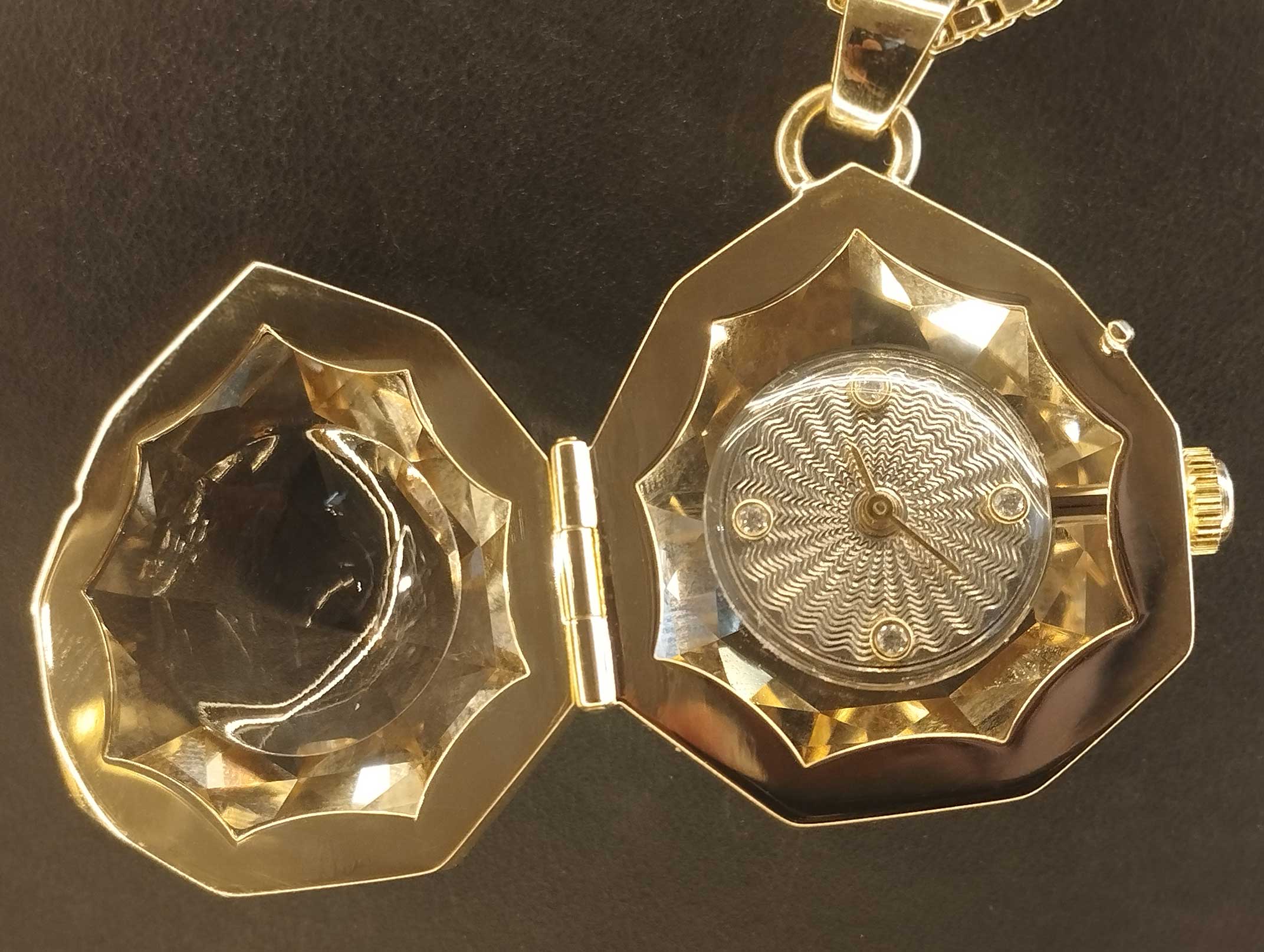
When worn on a gold chain around the neck, the Florentine offers a truly regal wearing experience. Originally, it adorned emperors and empresses. Today, glimpses of the movement and dial can be seen through the stone, but it is only when the piece is opened that its secrets are revealed.
The centrepiece of this exceptional jewellery watch is a citrine split down the middle, which is almost identical in shape and colour to the Florentine. Within it is a high-quality, hand-wound mechanical movement with 17 jewels. The movement’s bridges and plates are hand-guilloché and rhodium-plated.
The 950 platinum dial is hand-guilloché and features four brilliant-cut diamonds set in gold.
The stone halves are set in 18-carat gold, as is the clasp mechanism, allowing the Florentine watch to be opened or closed at any time.
The first unveiling of the Florentine Watch, a unique piece, took place at the Austrian Embassy in London during London Craft Week 2026.